TDS
135.2 mg/L
n = 846
0
600 mg/L
- Typical range
- 156.7-294.4 mg/L
- Median
- 229.8 mg/L
- Position
- 19. percentile

Your tap water
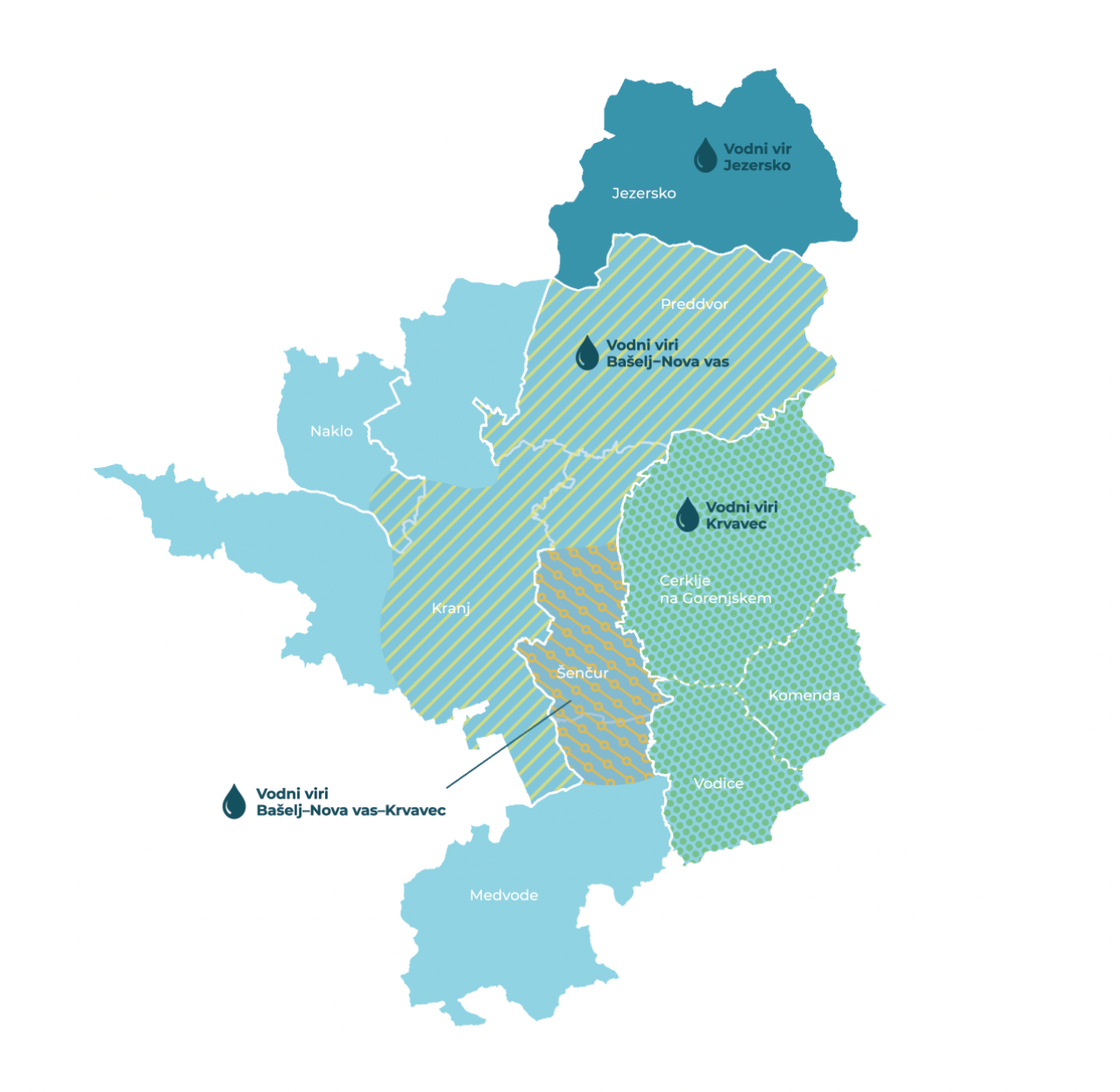
Water-source map
The display below helps explain the wider area of water sources and places connected to the Komunala Kranj system. The current sample is shown for the listed water supply and sampling area, while actual quality at an individual tap may also depend on the building's internal plumbing.
Analysis details
Each card below explains one part of the water: from mineral composition to the sommelier assessment and official laboratory report.
Comparison with Slovenia
The comparison uses the latest available sample from each water supply, so every system has equal weight.
At 1.5-2 L: 28.5-38 mg or 2.9-3.8% of the recommended daily intake.
At 1.5-2 L: 9.6-12.8 mg; recommended daily intake is 350 mg/day (M) or 300 mg/day (F).
For comparison, character is positioned using the same TDS calculation as card 6; it is not a water-quality rating.
TDS is a comparative estimate from electrical conductivity at 20 °C using a factor of 0.65. Hardness is calculated only where verified calcium and magnesium values are available. The typical range represents the middle 50% of compared water supplies.
Calcium, magnesium, sodium and other ions create the character of the water, so they are shown both as a readable profile and as laboratory values.
According to the World Health Organization (WHO), drinking water can contribute significantly to daily calcium and magnesium intake. Waters with lower mineralisation generally contribute less to daily intake of essential minerals compared with more mineral-rich waters.
The marker shows the measured concentration in water; the scale is set against approximate daily intake for a healthy adult.
EWSA: Total dissolved solids at 180 °C (mg/L)
TDS (Total Dissolved Solids) means the total amount of dissolved solid substances in water, most commonly expressed in mg/L.
TDS helps explain whether water feels light, gently mineral or more full when drinking.
Hover over or select a category for its explanation.
Because of the broad mineralisation range, it is important to understand the characteristics of each water, since its mineral composition influences sensory profile, mouthfeel and intended use.
Waters from public water supply systems are generally in the lower to medium mineralisation range, often approximately up to 500 mg/L total dissolved solids (TDS), whereas natural mineral waters and waters from specific geological environments can reach substantially lower or higher levels of mineralisation; these refer to bottled waters.
EWSA mineralisation ranges and TDS categories are an internal sensory and user-oriented classification. They are not an official medical or regulatory classification of drinking waters.
Initial sub-range on the displayed scale: 0-100 mg/L TDS.
Hydration* marks the lowest-mineralisation sub-range of the Hydration area on this EWSA scale. It helps locate a water precisely on the scale; it is not an additional medical or regulatory category.
Waters in this range generally have a very gentle sensory profile and little influence on the taste of tea, coffee, herbal drinks or lighter food pairings. Their complete mineral composition remains relevant to the final sensory impression.
Area on the displayed scale: above 100 and up to 500 mg/L TDS.
This category includes waters with a lower level of mineralisation that do not stand out by any single element. Such waters generally have a gentle and less pronounced taste, which also depends on the water's pH.
Waters in this category often pair well with tea, coffee and herbal drinks, as their gentler sensory profile has less influence on the sensory characteristics of the preparation. The final taste depends on the full mineral composition of each water. They can also be paired with lighter food, such as salads with delicate dressings or pasta with light sauces.
According to the World Health Organization (WHO), drinking water can contribute significantly to daily calcium and magnesium intake. Waters with lower mineralisation generally contribute less to daily intake of essential minerals than more mineral-rich waters.
There is no universally defined single international classification, but waters with lower total dissolved solids (TDS), often approximately up to 100 mg/L, are commonly understood as low-mineral waters.
When everyday nutrition is low in minerals, water with a higher mineralisation can contribute to a more balanced mineral intake.
Area on the displayed scale: from 500 to 17,000 mg/L TDS.
This category includes waters that stand out because of their mineral or ionic composition and the level of individual components. Although fluid intake remains one of the basic roles of water, the choice of such water is often linked to specific mineral or sensory characteristics or to a particular nutritional purpose.
In addition to hydration, such waters may be selected with a specific purpose, for example when a person wants to increase or limit the dietary intake of selected elements. Waters with higher mineralisation or higher TDS have a more pronounced ionic composition and can contribute more significantly to the intake of minerals such as calcium, magnesium, sodium, hydrogencarbonates or sulfates.
According to the WHO background document Total dissolved solids in Drinking-water, waters with TDS above 1200 mg/L are considerably more pronounced in taste and may be less acceptable to consumers. This is why such waters are usually consumed more thoughtfully and with a purpose.
This category may include:
For orientation, individual composition thresholds may also be relevant, such as low sodium content below 20 mg/L, magnesium at 50 mg/L, calcium at 150 mg/L, sulfate at 200 mg/L, hydrogencarbonate at 600 mg/L, iron or fluoride at 1 mg/L, and very low mineral content at TDS below 50 mg/L.
Such waters are therefore not treated only as water for everyday hydration, but as waters selected according to nutritional needs, personal circumstances and intended use. Their mineral composition can significantly influence taste perception, mouthfeel and gastronomic use.
Specific use is a narrower interpretation within this area. It refers to waters with a characteristic mineral or ionic composition for which special properties and effects on the human body have been confirmed using scientifically recognised methods and appropriate documentation. Examples include diuresis, effects on gastric and intestinal function, and compensation of mineral deficiencies.
Such waters are usually consumed purposefully, according to their mineral and ionic composition and the recommended manner of use.
This category often includes:
For such waters, producers often also provide recommendations concerning:
This description is an interpretative EWSA classification. It does not mean that every water in this range has such effects; they must be supported by appropriate documentation or confirmed research.
The area above 17,000 and below 30,000 mg/L TDS is intentionally left without a displayed EWSA label on this scale.
Adriatic sea-like taste is marked only at the threshold of 30,000 mg/L TDS.
Adriatic sea-like taste is marked at the threshold of 30,000 mg/L TDS.
This category indicates a strongly mineral, salty impression that can remind the user of Adriatic sea water, similar to the taste sensation associated with swimming in the sea.
It is an EWSA sensory and user-oriented description and not a regulatory category.
These categories support a professional, sensory and user-oriented interpretation of the characteristics of individual waters.
The classification is not a medical, health or regulatory categorisation of water and does not represent a health or nutrition claim.
The categories are based primarily on:The Specific use category identifies waters with a characteristic mineral or ionic composition or manner of use, where special properties are supported by confirmed research, scientifically recognised methods or appropriate documentation; it is not a general health or medical claim concerning the effects of the water itself.
Water hardness represents the total concentration of calcium and magnesium ions. In addition to influencing limescale formation, it also significantly shapes the sensory properties of water, such as texture, fullness and mineral character.
Scale source: Water Quality Association (WQA); interpretation: European Water Sommelier Association.
Formula: 19 mg/L Ca (calcium) x 2.497 + 6.4 mg/L Mg (magnesium) x 4.118
Water hardness is mainly determined by the minerals calcium and magnesium. Higher concentrations of these minerals mean higher water hardness.
Hardness mainly influences:
Total hardness is internationally standardised and expressed as calcium carbonate equivalent (CaCO₃).
Waters with higher hardness usually have a more pronounced mineral character and a fuller mouthfeel. In sensory analysis, differences in hardness can often be perceived through water texture, mineral intensity and an overall sense of mineral fullness.
pH helps describe acidity or alkalinity; the actual sensation is also connected to minerals and water temperature.
Alkaline
pH describes the acidity or alkalinity of water. Sensory perception also depends on the full mineral profile, TDS, temperature and individual perception.
Lower pH can feel fresher or lightly acidic, neutral waters tend to feel balanced, while higher pH can feel rounder, alkaline and may also taste bitter.
The pH value is taken from the laboratory report and automatically shown on the interpretative scale.
The pH scale 5.0-10.0 is divided into EWSA sensory ranges, with the current analysis automatically highlighted in the appropriate range.
Sensory perception of water does not depend only on pH value, but also on:
The pH value by itself is not an indicator of water quality or health suitability.
Interpretative sensory descriptions of pH value are part of the internal methodology of the European Water Sommelier Association (EWSA) and are not a health or regulatory classification of water.
Sensory water profile based on 11 EWSA assessment criteria.
Primary tastes: gentle sweet acidity and a sensation of milk fat
Secondary tastes: soda-like and rocky taste
EWSA
Understand your water. Create better food and water pairing.
This category includes light and gentle waters that enhance subtle flavours.
This category includes balanced waters that complement stronger flavours and create a harmonious culinary experience.
This category includes fuller, mineral-rich waters that pair well with rich, intense and expressive dishes.
The basic goal of pairing water with food and beverages is to achieve a balance of flavours, where tastes do not overlap or distort one another.
Properly selected water does not cover the taste of food or other beverages, but highlights their natural aromatics and texture.
If you would like to elevate the experience of pairing drinking water with food and other beverages, contact our EWSA centre, where we can help you create a more effective approach in the world of fine cuisine.
If you would like to follow new features, research, water-quality standards and the development of water pairing with cuisine, leave your email address. We will notify you when important updates are available.
ewsa@bledwf.comWater treatment: ultrafiltration
Displayed safety parameters comply with the listed limits.
Results marked with '<' mean the concentration was below the determination limit of the laboratory method used.
The complete official laboratory report is available as a PDF.
Bled Water Forum · EWSA
Slovenia has the right to clean drinking water written into its Constitution (Article 70a, 2016).
The goal of Bled Water Forum and the European Water Sommelier Association (EWSA) is to promote a broader understanding of drinking water, its quality, mineral composition and the importance of responsible water-resource management. Through knowledge transfer, we want to contribute to greater awareness and understanding of water and its role in everyday life.
We believe that understanding water, its origin, composition and quality is an important part of a responsible attitude toward drinking water and the sustainable management of future water resources.
Access to safe, high-quality drinking water is one of the fundamental values of modern society, and an important part of that access is the ability for each person to understand the water they drink.
If you are a water provider and would like to join the project, or if you are an individual looking for more information about drinking water, you can contact us.
ewsa@bledwf.comProfessional basis
The interpretative display uses publicly available professional, legal and reference sources.
Join the project
This form is intended for water providers that want to submit their official data, join the public display or arrange publication of notices.
At this stage we collect only water-provider data submitted by the provider for the purpose of project contact.
Provider notices
The section below is prepared as an initial space for official provider data and future notices that the provider may want to publish for a water supply or sample.
For now we collect and display only data submitted by the water provider. No broader notice system is used yet.
The next step is a system where providers can publish official notices and additional information for their water supplies.